


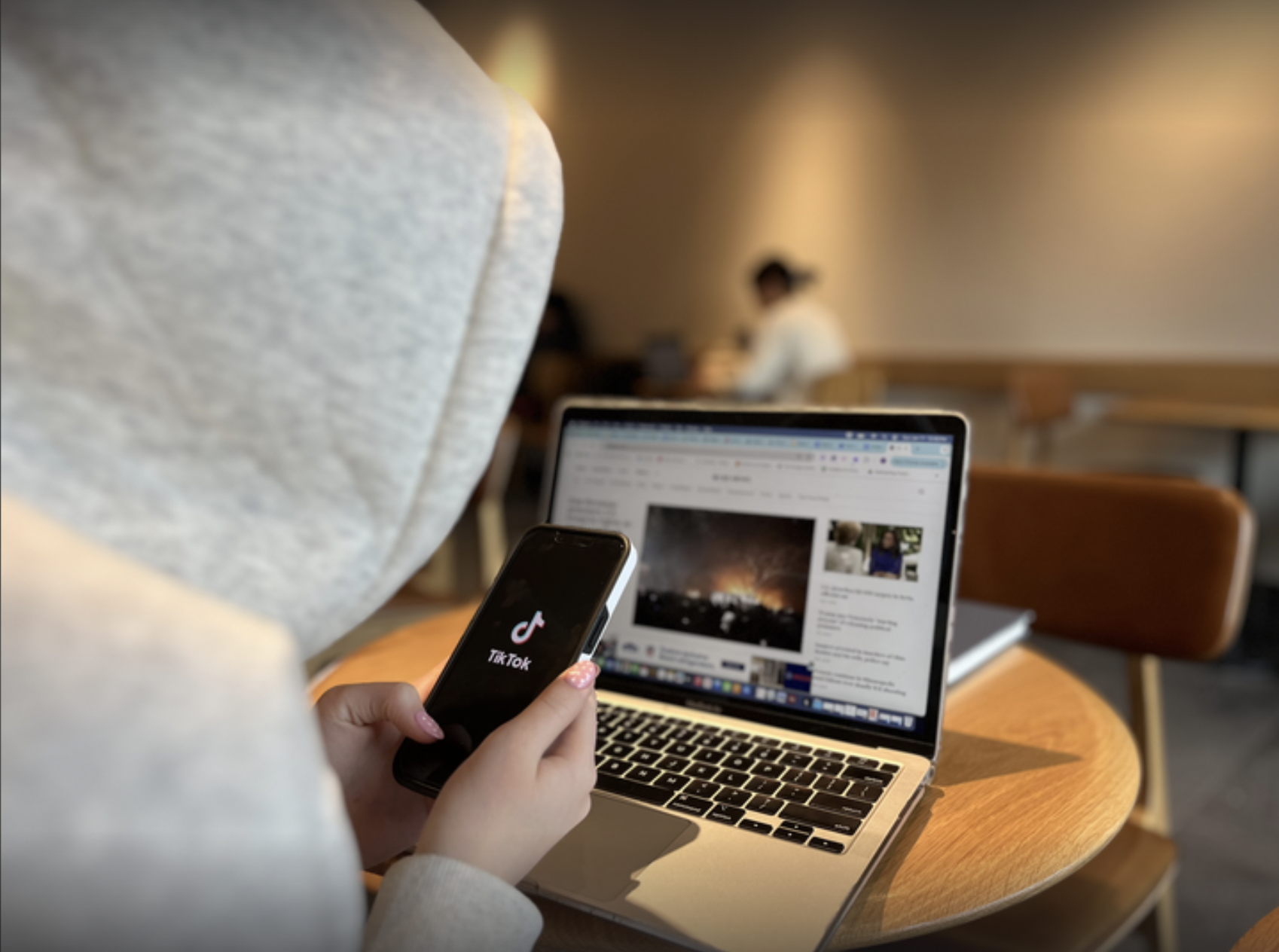
The average attention span for humans is 8.25 seconds, less than a goldfish’s attention span of 9 seconds. As digital devices increasingly pull attention away, concentration levels are declining, and news outlets and journalists are struggling to keep up with AI and social media to win public attention.
But why aren’t people reading? Information has never been more accessible. In the age of technology, the internet can relay news to the public within seconds. Still, for some, keeping up with the news feels like a chore. With social media capturing the attention of teenagers and adults alike, trust in the news has eroded, and the emotional toll can push people away.
“People are not news literate in general,” Boston College journalism professor Kevin Convey said. “Most people, and especially younger people, don’t get their news from news outlets directly at all.”
About half of young adults in the U.S. go on social media sites such as TikTok on a daily basis, with its fast-paced nature cultivating a space where both information and misinformation can spread quickly. A Wayland High School survey found similar trends. 75% of surveyed students said they rely on social media as one of their primary sources of news.
“It’s honestly inevitable that people get their news from social media, because that’s the easiest way to get it,” former editor-in-chief of WSPN and freshman at the George Washington University Reva Datar said. “It’s the most consumable way to get it.”
A Pew Research Center study reported that young adults are more likely than older adults to trust social media for news, and they are less likely to trust information from local or national news organizations. This mistrust in news is seen across both Democratic and Republican parties and it isn’t new. Historians have traced skepticism toward the press back to the 1800s, when some newspapers used hyperbole and catchy headlines to dramatize issues and sell more papers.
“Journalism itself is responsible for some of this [distrust in media] because it had gotten to be this huge enterprise that had gotten distanced from its audience, [and] that didn’t cater to its audience at all,” Convey said.
Specifically in digital media, the rise of digital sensationalism has become a growing issue, with anyone on social media able to post almost anything at any time. While misinformation has long been a problem in media, the rise of social media has only escalated it, some experts say.
“The problem with getting your news from social media is you have no way of knowing, unless you go back to the source, whether or not what you’re reading is correct, fair or balanced,” Convey said.
With political division, economic uncertainty and violence around the world, it can be exhausting and disheartening to see nonstop conflict in what feels like every headline.
“The news can be very depressing and anxiety-causing, especially recently,” an anonymous WHS student said. “It feels like it’s always negative and hateful.”
In the same WHS survey, only 19% of students said they frequently read the news, and 38% said they intentionally avoid it. Some students say this aversion is due to the distance they feel from major events, along with the emotional toll of the news.
“In a town like Wayland, you are kind of isolated from a lot of what you hear in the news,” Datar said. “It doesn’t seem very important. It doesn’t seem very urgent.”
It can be easy to feel detached from the news if you don’t feel directly affected by it. For some Wayland students, that sense of isolation can create distance from the national and global news unfolding each day.
“I just feel like I don’t really need to know a lot of the information [news outlets] provide on the news,” an anonymous WHS student said.
While the news can feel irrelevant to some, there are benefits to staying informed about the world around you, even when it feels distant. Datar emphasizes the importance of understanding perspectives and experiences that differ from your own. Coming from the more sheltered town of Wayland and then moving to the nation’s capital, she said current events felt more “present” and “immediate.”
“When you meet different people in college as you grow older, you want to be able to interact with those people,” Datar said. “You want to be well informed about who different people are [and] what different parts of the world are like, because that’s just the reality of what it is.”
According to Convey, not only is it important to read the news, but it’s essential to avoid only reading information that backs up a person’s existing beliefs, which can lead to selective information consumption of information and a narrow view of the world.
“Real news does not have a point of view,” Convey said. “It is an assemblage of facts put together in the most accurate way possible, and it is not designed to comfort anybody or to confirm anybody in a pre-existing bias.”
This confirmation bias is present in some news sources, where reporting is done solely on topics that will maximize audience interest, rather than focusing on the larger truth.
“As a journalist with ethics, I’m not going to slant the news because my audience would prefer me to do that,” Convey said. “My job as a journalist is to find out what the truth is, report it and let the chips on that fall where they may.”
According to Convey, avoiding the news, or consuming it in a way that only reinforces confirmation bias, can weaken democracy. Convey adds that the First Amendment was created to give a voice to Americans and support an informed public.
“If you’re not an informed citizen and you go and you vote based on your biases or incomplete information, you’re not discharging your duty as a citizen properly,” Convey said. “You’re not doing what the founders [of America] [intended].”
Bob Hicks • Jan 14, 2026 at 8:35 PM
Such a well-researched and well-crafted piece! Congratulations Annabelle!
Brandon • Jan 13, 2026 at 10:53 AM
Awesome article Annabelle