
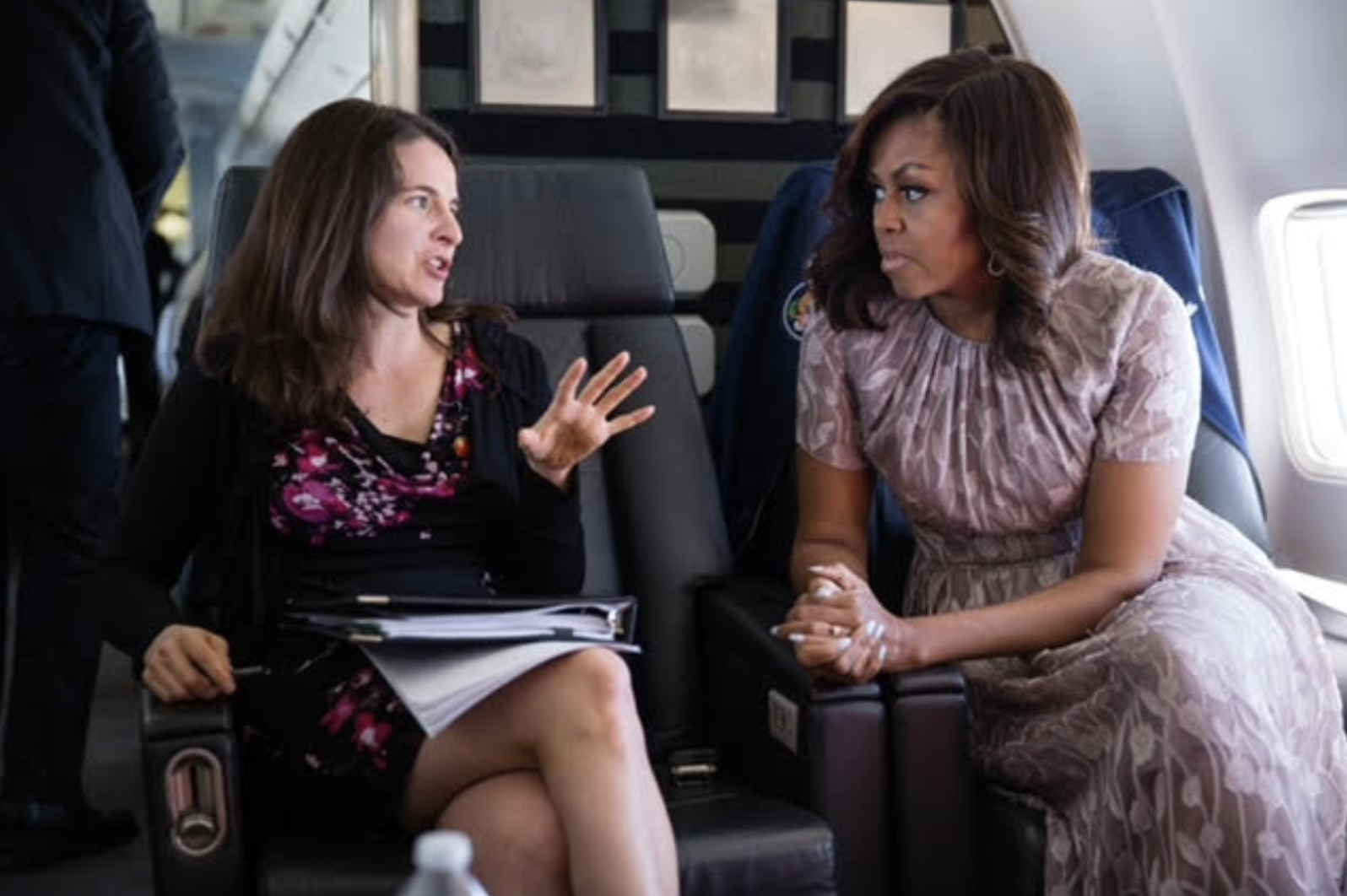


Speaking, writing a book and delivering speeches all have one thing in common: They use words to convey thoughts and ideas. From speechwriting for President Barack Obama and first lady Michelle Obama to becoming a New York Times bestselling and award-winning author, Wayland High School alumna Sarah Hurwitz is a prime example of someone who uses her words strategically to share impactful ideas.
Speechwriting
Ideologies, thoughts and ideas are often woven together in a political figure’s speech. Speeches convey a politician’s character to the nation and can be crucial to a campaign. However, politicians do not always write their speeches from start to finish. In fact, professional speechwriters are often behind the scenes. Hurwitz is one example of a successful speechwriter who has used her skills to craft speeches for influential politicians, including the president of the United States.
“It is [a president’s] power to use their rhetoric and speech to influence the direction of the country,” WHS AP U.S. Government and Politics teacher Laine Winokour said.
Before Hurwitz became a senior speechwriter, she interned in former Vice President Al Gore’s advanced scheduling department. There, she managed his calendar of events and had little connection to the speechwriting world. It was not until she connected with someone in the speechwriting department at an event that she learned about the field and switched to an internship in that department.
“So that was really a very lucky moment of meeting this guy and thinking like, ‘Oh, speech writing sounds so interesting,’” Hurwitz said.
After her internship, she went on to work as a speechwriter for Sen. Tom Harkin. During her time with Harkin, she realized she was not a naturally gifted speechwriter. Members of Harkin’s staff suggested she take time to attend law school rather than continue pursuing speechwriting.
“The issue was that I just lacked the training, and so I think it’s really important if there’s something you’re passionate about, to go and get the training in it,” Hurwitz said. “Find people who are good at it and learn from them. Don’t get discouraged if you fail at first, [and] it’s really important to just keep learning and training and working.”
Hurwitz took the staff member’s advice and was later accepted to Harvard Law School. During her time there, she and her friend Josh Gottheimer, who is now a congressman, worked as freelance speechwriters. Hurwitz said that being initially steered away from speechwriting taught her the value of having a partner such as Gottheimer, who helped her grow as a writer.
Their freelance work eventually led both of them to positions on Gen. Wesley Clark’s 2003 presidential primary campaign.
After Clark’s campaign, Hurwitz joined Sen. John Kerry’s 2004 presidential campaign. After completing her work there, she stepped away from politics and worked as a lawyer at a law firm for two years. Following her time at the firm, she was hired as a speechwriter for Hillary Clinton’s 2008 presidential campaign. She was later brought on as a speechwriter for B. Obama’s presidential campaign.
The goal of a president’s speech is to convey messages they believe are important to their audience. Through carefully chosen words and emotion, they seek to influence how listeners think and act.
“Obama, my understanding is, his speech writers, he worked with them, and it was a very collaborative process where they would fine-tune language and make sure what he said was really what he meant,” Winokour said. “So it’s important that what you’re saying is reflective of what you want or what you think is important for the country to know.”
While working under Obama, one of Hurwitz’s most memorable experiences was writing a last-minute graduation speech for the president. She had previously written his first commencement address, but amid the economic crisis during the 2008 stock market crash, he had not had time to review it. On the day he was scheduled to deliver the speech to a large audience, he decided it was not what he wanted to say. Hurwitz had to quickly draft a new speech while traveling by helicopter, plane and motorcade.
“I was so worried, but he just delivered it so beautifully,” Hurwitz said. “He was totally not stressed, very calm the whole time, [but] I was very stressed.”
Hurwitz later transitioned to working with Michelle Obama on a range of speeches, including her 2008, 2012 and 2016 Democratic National Convention addresses.
According to Hurwitz, crafting those speeches was a multistep process that required significant thought. She would first sit down with Michelle Obama to identify the main themes she wanted to convey. Hurwitz took notes on her stories and ideas, drafted the speech and then fact-checked it with 50 to 60 people. Afterward, Michelle Obama reviewed the draft, made her own edits and practiced the speech with Hurwitz to determine what worked and what did not.
“She would dictate pages of really fresh, beautiful language, stories and ideas,” Hurwitz said. “ Then I would go back to my office and spend a few days really kind of working that into a draft.”
Hurwitz sought to channel her speaker’s goals and ideas into each speech, rather than dictate what they should say word for word.
“A job of a speechwriter, it’s not to script someone, it’s not to tell them what to say,” Hurwitz said. “It’s really more to channel them. Michelle Obama knows who she is and she always knows what she wants to say, so my job was not ever to put words in her mouth.”
One of the highlights of speechwriting, Hurwitz said, was the opportunity to travel the world and witness the impact the Obamas had on people.
“[The Obamas] really represented a lot of hope and optimism to a lot of people, especially young people, and getting to see that was pretty extraordinary,” Hurwitz said. “[I] see the way that the Obamas touched and inspired people from so many different backgrounds.”
Hurwitz added that another highlight was seeing how excited people were to welcome Americans to their country.
“During the Obama administration, America had a very good reputation in the world,” Hurwitz said. “When we touched down in a country in this big blue and white plane that said United States of America, people often welcomed us with open arms and we were really excited to see us.”
Hurwitz retired from speechwriting in 2017, marking the end of her decade-long career in the field.
Connecting culture to written word
After retiring from speechwriting, she continued to use her gift for words by writing books such as “Here All Along” and “As a Jew,” both of which center on her Jewish faith.
“I really want readers to understand that Judaism has so much wisdom that is so relevant and important for us today,” Hurwitz said.
When Hurwitz was younger, she attended synagogue a few times a year. However, after her bat mitzvah, she disengaged from Judaism. That changed after a breakup, when she enrolled in an introduction to Judaism class and reconnected with her faith.
“It just was so mind blowing to me to discover that Judaism has 4,000 years of wisdom about what it means to be human,” Hurwitz said. “So much wisdom about how to be a good person and lead a worthy life.”
After the class, she decided to explore Judaism more deeply and learn about its culture, traditions and beliefs. That research and curiosity led her to write her first book, “Here All Along,” in which she explains Judaism and its message.
“So I spent years, you know, taking classes and reading books and studying with rabbis, and I just decided to write my first book, which was really about the brilliance and insight and transformative wisdom of Jewish tradition,” Hurwitz said.
In 2023, Hurwitz said she began to notice rising antisemitism in the United States. Antisemitism is prejudice or hatred directed at Jewish people. According to national surveys, 33% of American Jews say they have been targeted by antisemitism.
Wayland has not been exempt. In 2025, a swastika was painted on the Wayland Community Pool, one of several incidents that have affected the community.
“[Antisemtism] plays a huge role because there are so many wrong, ridiculous stereotypes out there, and educating people about what being Jewish truly means, what that identity means, is really important towards crushing those generalizations,” former Jewish Student Union member and WHS sophomore Ariana Price said. “Education is a powerful way to combat hatred because most hatred stems from a lack of information.”
In response to rising antisemitism, Hurwitz wrote another book, “As a Jew,” to educate readers about how such hate affects the Jewish community. “As a Jew” was named a New York Times bestseller and received the Natan Notable Book Award. In the book, she challenges harmful stereotypes about Jewish people and warns about the dangers of antisemitic views.
“I think that what we know from history is that anti-semitism tends to flare up when people are feeling insecure, when they’re feeling economically insecure, politically insecure, and then they look for someone to blame,” Hurwitz said. “I felt really committed to being a proud, passionate, public Jew and showing people who Jews are, what Judaism is about and speaking out against the antisemitism we are seeing.”
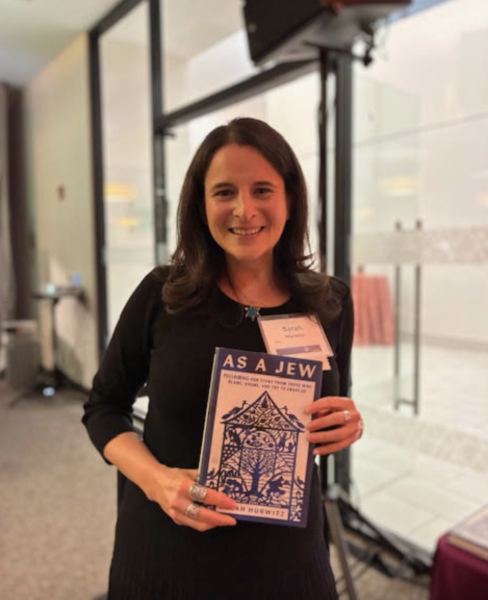
(Credit: Sarah Hurwitz )
In addition to addressing antisemitism through her writing, Hurwitz was appointed by Barack Obama to serve on the U.S. Holocaust Memorial Council. The council helps oversee the United States Holocaust Memorial Museum and works to ensure the nation remains educated about the Holocaust. Hurwitz continues to serve the museum and helps raise awareness about what it means to be Jewish in this country.
“Jewish people are one of the most targeted groups in the world, so it’s essential that everyone understands how severe and widespread this problem is to help combat that hatred,” Price said. “Hatred in any form involves everyone and should urge everyone to take action.”
From speechwriting to speaker
In addition to writing books, Hurwitz became a public speaker after leaving the White House, educating audiences on how to be an effective communicator.
“Back then, I was speaking mainlyly about communication and how to be a clear, effective and persuasive communicator,” Hurwitz said.
Hurwitz continues to speak at colleges, schools, synagogues and workplaces. She addresses topics including Judaism, antisemitism, behind-the-scenes experiences in the White House and lessons from her career.
“I’ll just talk to people about the topics of my books and my goal really is to educate people, to inspire people, to inform people, to help people fall in love with Jewish tradition and how to be really proud, committed and passionate Jews,” Hurwitz said.
From her perspective as a speechwriter, author and speaker, one of the most important lessons Hurwitz learned is to pursue opportunities and passions when they arise. She urges people not to let their dreams slip away.
“I also think it’s just important to notice what really sparks your passion,” Hurwitz said. “There are risks of not accepting opportunity, which is the risk that you’re not leaving a life that’s really your own.”
Another lesson Hurwitz emphasizes is the importance of listening and considering others before speaking.
“I think there’s a really valuable lesson there where it’s like, you should really try to understand other people’s perspectives, and then when you share your own, you can do so with a little bit more compassion and nuance,” Hurwitz said.
Brandon • Mar 2, 2026 at 1:09 PM
Such a cool article, Karis!