
Is the stress worth it? The reality of preparing for college applications


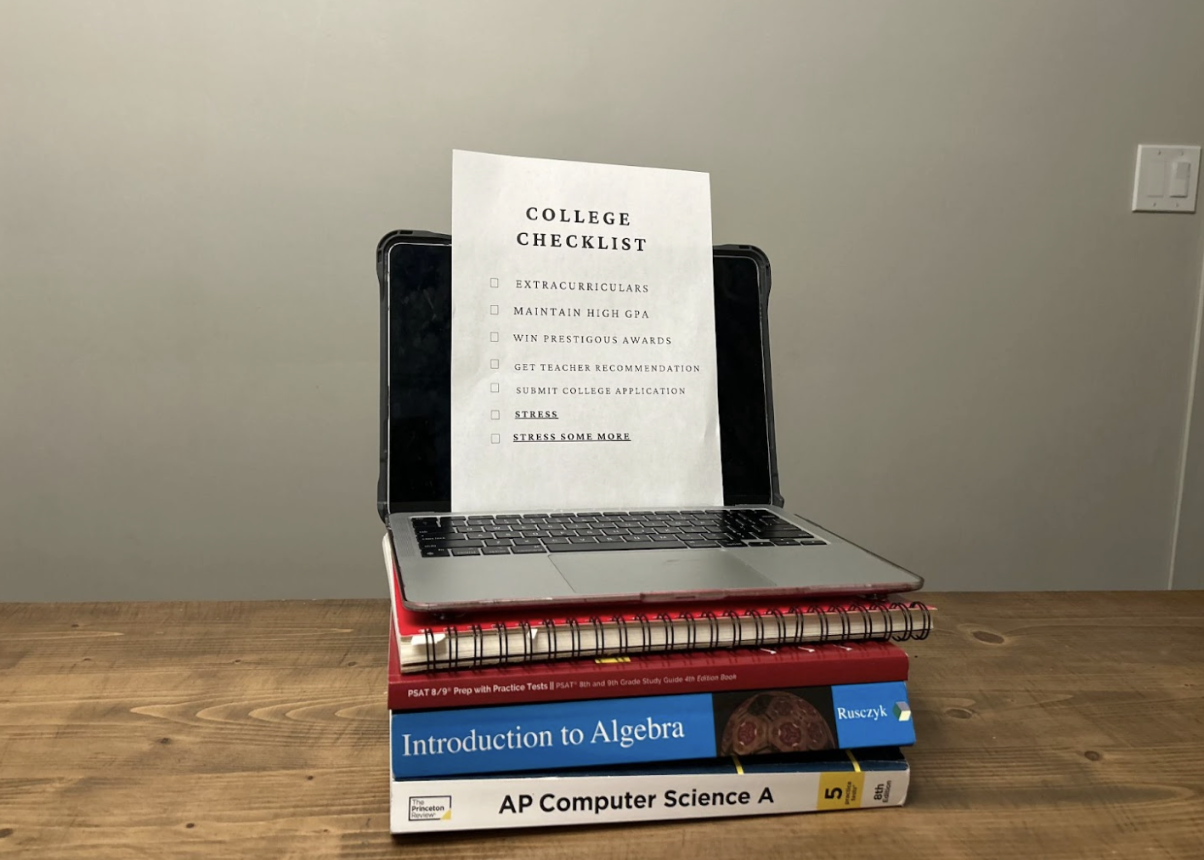
With a 3.6% acceptance rate to Harvard University, a 6% acceptance rate to Duke University and a 5% acceptance rate to Northeastern University, some teenagers can’t help but think about ways to optimize their chance of acceptance. However, is there a limit to thinking about college before it crosses into obsession? How can this stress around college be handled?
According to the latest report from the Common App, a college application website, there’s a 10% increase in college applications for a limited number of spots in college. In addition, there’s a trend of colleges lowering their acceptance rates. For example, New York University (NYU) released their lowest acceptance rate in 2025. The lack of available seats in college, with an increasing amount of competition, can be extremely concerning for students and families. The application process can also lead to doubt and regret for some students regarding their time in high school.
“[A] stressful part of [the application process] was that I felt that everything I had done just wasn’t good enough, such as my grades and test scores,” senior Cara Hill said. “It made me regret my whole time throughout high school, and had me rethinking what I could’ve done differently in each class to improve them, which looking back now, was a waste of time considering I can’t go back and change the past.”
Traditionally when applying to college, all applicants have to fill out a college application, which includes school transcripts, essay(s), letters of recommendation, a list of extracurriculars, awards and test scores. However, the pressure to create the “perfect college application” can cause stress to some students, as the application is their only chance to stand out in a large field of peers.
“I think a lot of kids feel pressure to have everything sorted out by the time they’re 15 or 16,” Wayland High School Guidance Counselor Benjamin Buffa said. “For most people, it’s just not realistic, and I think, in some ways, that’s kids putting unnecessary pressure on themselves.”
The stress of creating a sufficient application can put pressure on students. With grades, extracurriculars and time all being factors to juggle, this pressure can weigh on the minds of college applicants.
“I think the biggest weight, at least for me, was just that it was another thing to do, and that there was schoolwork and studying piled on top of it, kind of sinking you into the ground,” Hill said. “I feel that another weight is the worry that you’re not going to end up at the right place, or that other Wayland students may judge the college that you go to.”
Grades are one of the most important things that factor into a college acceptance. The rigor and performance of students and their coursework is reflected in their transcript. For some high schoolers, it can feel like the point of high school is just to get into college by chasing a 4.0 GPA and straight A’s. In some cases, the need to achieve those expectations can be unrealistic and lead to disappointment if that goal is not achieved.
The WHS counseling department strives to steer students away from solely focusing on achievements, but rather look at high school as a way to nurture passion and curiosity.
“This whole system rewards grades,” Buffa said. “So it’s like, how do we get away from that and deprioritize needing perfect grades and prioritize learning and making mistakes and recovering?”
Extracurriculars are also a major part of the college application. Whether it’s publishing research papers, interning or running a club, colleges value a well-rounded candidate. However, it can be stressful for students to curate an extracurricular portfolio. The worry about how colleges perceive activities, rather than how much students actually enjoy doing them, can creep in, adding to overall distress.
“If you don’t love what you’re doing, it’s going to come out, somehow, some way,” College Counselor Amanda Ciaccio said.
Another source of stress is the lack of knowledge that stems from late planning. Starting college planning during senior summer is the wrong move, as it doesn’t allow time for selecting desired school courses, finding financial aid opportunities and looking at college options. Late planning can be anxiety inducing for students, as it can create an added time crunch.
“If you wait until the summer before senior year to start thinking about it, you’re going to become so overwhelmed,” Ciaccio said. “You’re also at a disadvantage in terms of finding the right fit, whether that be academic, social or financial, because you’re just not going to have the time, not to mention all the work that needs to get done.”
On top of this, according to Buffa, kids and parents tend to assume a “narrow mindset” when it comes to colleges. A “narrow mindset” encapsulates the thought that a student can only be successful if they attend a high ranking, four year college. This mindset can create tension and an additional source of pressure, as it can close doors and set the bar high for students when it comes to picking colleges.
“I think [WHS] has a large population of kids and parents that really see college as that ticket to the upper middle class and that you have to go to those top schools or else,” Buffa said. “They buy into that narrow path myth, and there’s that feeling that if my kid doesn’t get in there, they’re not going to get a big enough piece of the pie, or they’re not going to have a good enough life.”
While stress can lead to burnout and mental health problems, there can be a positive correlation to stress. Eustress, a positive stress, drives a person to get things done and can actually benefit a student in the college admissions process.
“It’s normal for some kids to have that healthy level of stress,” Buffa said. “Some stress is good, it motivates you, it makes you focus and it makes you work harder.”
This eustress can be channeled into starting the college planning process early and getting a head start. Starting college planning early can prevent surprises while filling out a college application. By looking ahead at the course requirements for target colleges, as some colleges have language requirements and other credit quotas, students can plan their high school experience in a way that can benefit their application process.
“In my experience, stress usually arises when students discover unknown requirements or criteria too late to take action,” Ciaccio said. “Early planning helps students avoid these pitfalls, focus on what they can control and navigate the college process more confidently.”
One concept that can be implemented with early planning is “chunking.” Chunking is the process of breaking a project or long term goal into manageable pieces. By creating a reasonable, consistent plan, chunking can make the college journey more manageable, piece by piece.
“I feel like when people can check off action items, it alleviates stress, so it’s kind of that concept of chunking,” Ciaccio said. “[Chunking] breaks [the college application process] into smaller [pieces] that you can process more easily and manage and not become overwhelmed about.”
Another piece of advice that Ciaccio offers students is to pick extracurriculars that they love. Extracurriculars are a vessel to feed curiosity and enjoyment, not necessarily items on a checkbox for college.
“I believe in being actively involved, but I believe in being actively involved in things that you enjoy,” Ciaccio said. “I think you’ll do better at something that you enjoy, and then the time will fly by.”
According to Ciaccio and Hill, it is best to focus on what an applicant can control and leave what they can’t control out of the picture.
“[A] piece of advice is to not really try to control things that are out of your control, such as other people’s opinions or test scores that you can’t change now,” Hill said.
Additionally, Buffa suggests that it is beneficial to not get trapped in the “narrow pathway to success” narrative. There are many ways to be successful, and they don’t always involve taking the hardest possible classes in high school, going to a highly-ranked four-year college and then working a high paying job.
It’s important that students remind themselves that there are other options out there that may suit them better than others. Less well known and selective colleges could be a good pathway for some students. Culinary, military and trade schools may not be viewed as the most traditional pathways, but for some, they are the best. Gap years are also an option for an alternative pathway. By not automatically crossing these options off, and remembering to keep an open mind when it comes to potential pathways, students can take some of the weight of college admissions off their shoulders
“There’s lots of pathways to a successful future,” Buffa said. “A lot of times those less selective schools are going to be the ones that offer more money or better financial aid packages. You’re going to get more opportunities for research, for internships, for grad school placements, for whatever it might be.”
Your donation will support the student journalists of Wayland High School. Your contribution will allow us to purchase equipment, cover our annual website hosting costs and sponsor admission and traveling costs for the annual JEA journalism convention. Please be aware that the hosting platform retains a 10% processing fee, and donations are not tax-deductible.
Glenn Davids • Mar 27, 2026 at 1:28 PM
What a well written (and spoken) analysis. There is so much pressure these days, it’s so important to look for ways to redirect the stress and anxiety, and this article and podcast suggest alternative ways of facing this burdensome, yet very exciting time of life.
graduating senior • Mar 26, 2026 at 1:53 PM
Honestly, as a senior looking back I wish I was kinder to myself. I wish I gave myself more grace when I struggled, and I wish I realized that everyone is in this process together and there’s no reason to compete with one another.
A lot of brilliant students I know at this school have a distaste for its culture for how competitive it is, and they are right because there’s no reason we should be comparing ourselves with one another. There’s enough resources in the world for everyone–we shouldn’t isolate ourselves as a means of “getting ahead”.
In a community, there cannot be only one doctor. There cannot only be one engineer. There cannot only be one musician. We should lift each other up so we can look after one another. In this world, that’s the only thing we can do.