

“Learning another language is not only learning different words for the same things, but learning another way to think about things,” journalist Flora Lewis said.
For students at Wayland High School, that statement rings true. Students at WHS had the opportunity to take the Massachusetts Seal of Biliteracy test through AVANT. They could take the assessment either in their home language or in a new language they study through WHS’s world language program.
The Seal of Biliteracy is offered through AVANT STAMP 4S, a program that tests students’ language skills in four areas: speaking, writing, reading and listening. More than 55 languages are offered, though not all include all four sections.
Languages with only speaking and writing sections are considered “super languages” because the seal is awarded based on those two sections alone. To earn the seal, test-takers must score a 6 or higher in each section.
AVANT STAMP 4S scores for the Seal of Biliteracy are based on ACTFL proficiency standards, which range from novice low to distinguished. These standards measure language proficiency at different points in a learner’s development. Typically, students who earn the seal score between Intermediate High, or 6, and Advanced High, or 9. The number on a student’s results corresponds to the ACTFL level they achieved. If students earn higher than a 7 in each category, or Advanced Low, they receive the seal with distinction, which recognizes a higher level of proficiency.
Results are released within seven to 10 business days and include feedback on how students can improve their language skills in the future. If test-takers earn a 6 or higher in three of the four sections, they can carry over that progress to the next year and work toward earning the seal.
The AVANT STAMP 4S test is adaptive, meaning the difficulty of questions and prompts changes as students move through the exam. Each test begins with the reading section, and based on a student’s answers, the questions and later reading passages become more or less advanced. A test-taker’s performance on each section also determines the difficulty of prompts in the next section.
Junior Joah Bigord, who took the test in Haitian Creole, said she did not realize the test worked this way.
“I didn’t know it was adaptive,” Bigord said.
Though Bigord acknowledged that this style of test can be difficult for some students, she felt the exam adjusted appropriately. Bigord also said she hopes “super languages” like Haitian Creole will eventually include all four sections instead of only speaking and writing.
Some universities recognize the Seal of Biliteracy and may award students college credit. The University of Massachusetts Amherst gives 12 credits to students who earn the Seal of Biliteracy and 15 credits to those who earn the Seal of Biliteracy with distinction. In addition to the possibility of earning college credit, the assessment can help prepare students for AP language exams, which test similar skills.
WHS and the Seal of Biliteracy
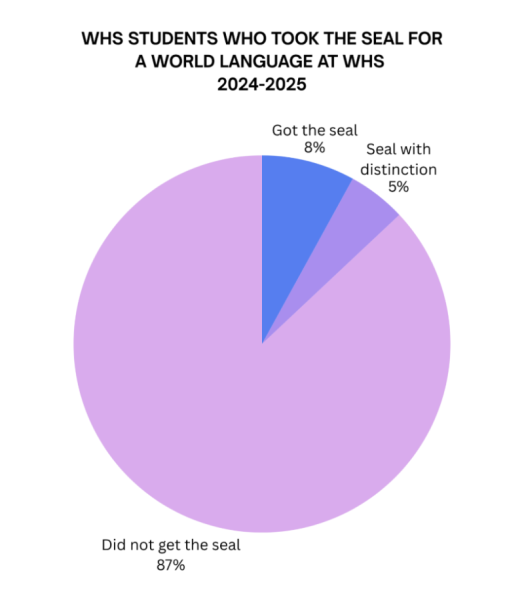
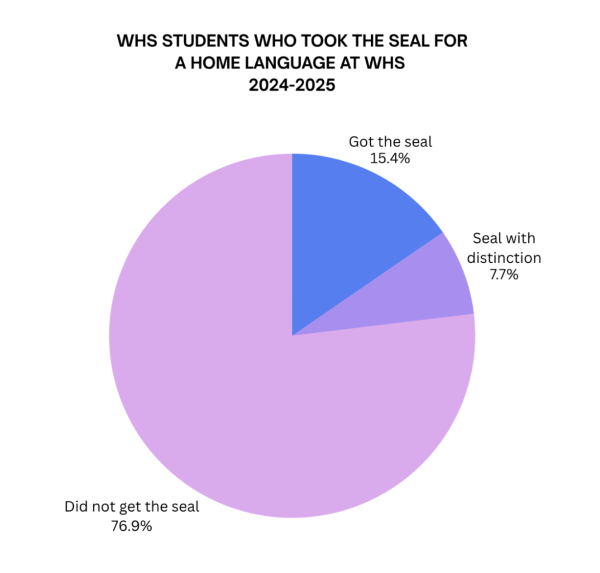
Though this year’s statistics are still being calculated, last year 100 students enrolled in a world language at WHS took the test. Of those students, 13 earned the seal and five earned the seal with distinction. Among students who took the test in a language spoken at home, 28 took the test, six earned the seal and two earned the seal with distinction.
This year, WHS switched from the Assessment of Performance toward Proficiency in Languages (AAPPL) to AVANT STAMP 4S to administer the test. The AAPPL test is longer and gives six speaking and writing prompts, compared with three prompts each on the STAMP test. Language Department Head Alaina Ghetti and world language lab technician Sandra Cincotti administered the test at WHS and said the change has affected both test-takers and proctors.
“[This year] I noticed that we had a large number of seal earners, but a smaller number of seals with distinction,” Ghetti said.
According to Ghetti, in addition to changes in the ratio of seals earned to seals awarded with distinction, this year’s results show higher interpretive scores in reading and listening but lower output scores in speaking and writing. Ghetti also said the new test provider places more emphasis on students’ proficiency rather than their classroom performance.
In this context, proficiency refers to the ability to communicate successfully about a range of topics that are not assigned in advance. This differs from school language units, where vocabulary and themes are typically taught before an assessment.
“Those [proficiency prompts] are those proficiency based moments in the real world that you find yourself in,” Ghetti said. “You have to figure out how to communicate, whether or not you’ve had units in school that have explicitly prepared you for that.”
Examples of proficiency prompts include students’ goals, challenges they have faced, illnesses or injuries they have experienced, why they like living where they do and jobs they have held.
“[The assessment] requires a student’s language proficiency to navigate through it,” Ghetti said.
The new test format has shortened the exam and improved differentiation between classroom performance and everyday language proficiency.
“It is very much aligned with ACTFL terms and so for that I think it’s a very valuable measure of proficiency,” Ghetti said.
From the perspective of a test taker
Junior Lexi Roman took the Seal of Biliteracy assessment this year to test her French proficiency after studying the language for the past six years. Roman described the exam as a good opportunity to see how far she had come.
Roman said the speaking section was the most difficult, while the reading section felt more manageable because of its multiple-choice format.
“The hardest part of the test for me was the speaking because it was difficult to talk for a full two minutes and say things that really demonstrated how I knew the language,” Roman said. “I think reading is what is most often practiced in class and seeing the words is how I most easily recognize them.”
Senior Vlada Sargysan, who took the test in Russian, shared Roman’s sentiments. She found the writing section difficult because it was more labor-intensive, while the listening and reading sections were easier for her.
Sargysan also said many of the reading and listening prompts felt mundane and monotone.
“It took away from the aliveness of the language,” Sargysan said.
The length of the test proved challenging for students, making it difficult to maintain focus and motivation through each section. Though the test does not have a set time limit, most students take about four to five hours to complete it.
Roman also said the test was long and that breaks would have helped her perform better throughout the exam.
“By the end of the test it was definitely harder to focus,” Roman said.
Though both Roman and Sargysan said the test could be improved, they were grateful for the opportunity to demonstrate their language skills and potentially earn college credit.
Tips and tricks for earning the seal
Cincotti suggested that students taking the test in their home language practice writing in particular, and that all students plan their responses before speaking or writing, since prompts can be tricky and often include multiple parts.
“[It’s] easy practice,” Cincotti said. “You have to think through the strategy.”
Ghetti suggested that students use the button on the test that reads the prompt aloud in the test language.
“Click the button and hear the prompt in the language that you’re testing, because there are so many vocabulary words within the prompt that you could recycle,” Ghetti said.
Sargysan recommended taking breaks between sections, such as going for a walk to clear your head. She also advised students not to spend too much time trying to make their writing or speaking responses perfect.
“Aim for 80% [quality wise] and you’ll be done in no time,” Sargysan said. “You’ll realize it actually doesn’t sound that bad.”
From cognitive development to effective communication, language proficiency has become a valuable skill. With the support of language teachers and programs like the Seal of Biliteracy, students are encouraged to broaden their cultural perspectives and develop skills that can last a lifetime.
“I knew I could speak Haitian Creole, but I wanted to test my abilities in Haitian Creole, to see how fluent I really was,” Bigord said. “[The Seal of Biliteracy test] showed me how much I needed to improve, and what I needed to work on.”