Skip to Content

Artemis II: The start of humanity’s return to deep space


On April 10, 2026, the Artemis II mission ship splashed down to Earth from outer space. A record breaking group of four astronauts aboard the Orion capsule of the Artemis II Mission spent nine days in space, making observations and collecting data that could be used to potentially make Mars travel possible. This mission was not only significant through its findings, but along with its diverse set of astronauts and unique objective, the Artemis II mission marks a notable landmark in space travel.
Credit: Maddie Ferrer

On Wednesday April 1, the spacecraft “Orion” stood poised on the launch pad at the Kennedy Center in Florida, as four astronauts strapped in for a journey no human has taken in more than half a century. The Artemis II space mission sent four astronauts around the Moon, marking the National Aeronautics and Space Administration’s (NASA) first crewed mission into deep space since Apollo 17.

Created by NASA, Artemis II was a follow up mission from the uncrewed Artemis I journey which launched on Nov. 16, 2022. The Artemis I launch was the first in a series of missions attempting to research potential human settlement on the Moon for years to come. Currently, there are five Artemis missions aimed at returning humans to the Moon, with each getting increasingly more complex. The suspense was built for the launch of the Artemis II mission, as Artemis I had already been delayed several times.

“The Artemis I, which was unmanned, was already like five or six years behind schedule,” WHS astronomy teacher Kenneth Rideout said. “So this one also has been long anticipated, in fact, I was nervous they were never gonna do it, so I was super excited when they announced it.”

Not only is Artemis II the first crewed mission related to the Artemis series, it is also the first spacecraft with a crew traveling to the Moon for any space exploration project since the 1970s, making the astronauts aboard the Artemis ll the first humans in lunar presence in 50 years.

“I think the thing that is really exciting about Artemis for me is the way that it connects current space exploration with space exploration of our nation’s past,” WHS english teacher Kelsey Pitcairn said. “The Apollo program was such a technological highlight of American space exploration, and to be able to sort of return to that era, I think it is really exciting to see us have the capacity to do it again.”

Compared to past NASA crewed lunar missions, the Artemis II mission did not entail a moon landing. Instead, the mission was a flyby test of the spacecraft “Orion,” which was designed to orbit the Moon and test NASA’s deep space systems.

According to NASA, the Artemis II test flight will confirm that the system will support astronauts in deep space exploration and establish a sustained presence on the moon.

A revolutionary crew

Not only did the Artemis II bring exploration back to the Moon, the crew shattered the status quo. The Artemis II crew contained four astronauts, Commander Reid Wiseman from NASA, Pilot Victor Glover from NASA, and Mission Specialists Christina Koch from NASA and Jeremy Hansen from the Canadian Space Agency.

The diverse crew broke records beyond being the first people around the Moon in 50 years, as one of the two mission specialists, Koch, was the first woman ever to fly on a lunar mission. She was selected as a NASA astronaut in 2013, and she has set the record for the longest single spaceflight by a woman at 328 days during her time in the International Space Station where she was conducting scientific research in microgravity. Koch is also known for being a part of the first all-female spacewalk in 2019, which was when her and fellow astronaut Jessica Meir exited the International Space Station to fix a faulty battery on the station.

“I wish a woman would have been able to get to [the moon] sooner, but that frustration should not discredit the joy and excitement of the moment,” WHS junior and Women’s Club leader Sazie Wrentmore said. “I’m sure this moment will inspire many girls to do what otherwise could have felt impossible [and] I hope there will be more of an expectation that women are capable of doing wonderful things like this.”

Koch’s fellow mission specialist, Hansen, is also a title holder, being the first Canadian to travel around the vicinity of the Moon. Hensen is an astronaut from the Canadian Space Agency (CSA), and he was one of two recruits selected by the CSA through the third Canadian Astronaut Recruitment Campaign in 2009.

Glover, the pilot of Artemis II, is the first person of color to travel to the Moon. He began working at NASA in 2013, and he previously served as the pilot of NASA’s SpaceX Crew-1 mission to the International Space Station as part of Expedition 64. In total, Glover has logged 3,000 flight hours and 400 carrier landings.

The commander of the mission, Wiseman, is a former fighter pilot and test pilot. He was selected as an astronaut in 2009 and previously served as the Chief of the Astronaut Office from 2020 to 2022. He worked as a flight engineer on the International Space Station for Expedition 40 and 41, spending a total of 165 days in orbit and doing two spacewalks.

“For me, to see a more diverse crew go to the Moon, especially in the current political climate, is huge,” WHS senior and astronomy student Glen Burt said. “This is a very clear message from NASA, saying that space exploration and science in general is for everyone.”

The Artemis II crew trained for years to operate the Orion spacecraft, running full mission simulations and practicing every phase from launch to splashdown. They also prepared for emergencies like system failures and practiced survival and rescue procedures. They trained in real-world environments and rehearsed daily life in space related to sleeping, eating and hygiene routines.

They spent an abundance of time working with high-tech simulators that recreated the exact conditions of spaceflight. These simulations allowed them to practice communication with mission control and learn how to respond quickly in the case of unexpected problems.

What happened in space

Artemis II went farther than any mission in the past, with a total of 694,481 miles traveled. It broke the previous longest distance, completed by Apollo 13, by over 4,100 miles.
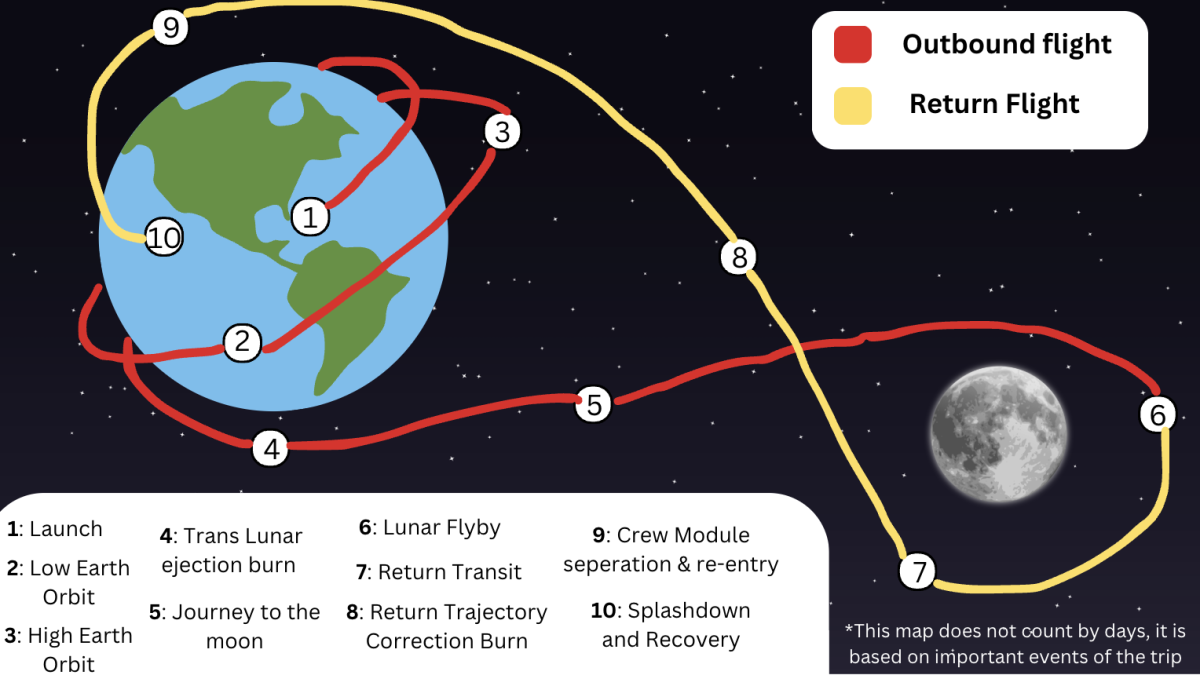
The first few days in space consisted of testing Orion’s capsule systems in Earth’s orbit, which included performing manual flying demonstrations and executing the translunar injection, which is the propulsion maneuver designed to push the crew towards the Moon. The crew also captured photos of the Earth from outer space.

Five days after the initial takeoff, Orion and the astronauts reached the Moon. During the lunar flyby, the crew observed and photographed views of the Moon that have never been seen by the human eye. The flyby helped collect data and information for better understanding of our moon.

“I’m glad that we were able to get back [to the Moon] for purely scientific reasons,” Burt said. “I am a very big believer in the fact that we should explore space more and generally understand more about the universe around us, and this felt like a really great step towards that.”

From NASA, the astronauts received what is called a “Lunar Targeting Plan” which was essentially Artemis II’s homework assignment. The Lunar Targeting Plan was a tailored scientific observation plan for the Artemis II crew, outlining specific lunar features to capture and study during their flyby. This included recording a 53 minute solar eclipse, observing lava flows, earthshine, which is a faint glow on the dark part of the Moon caused by the reflection of the sun and Earth, and craters on the Moon.

Since the Artemis II crew were the first to observe many of these features during the lunar flyby, they suggested names for what they saw. The proposed names for two craters, one named “Integrity” after the ship, and the other “Caroll,” in memory of crew member Wiseman’s late wife.

“[That moment], it was so beautiful, a lot of people think of astronauts in space exploration as being very “techie”, very sort of aloof and distant,” Pitcairn said. “But I think it just shows we’re all humans and so everything we do is going to have humanity in it, and I think moments like that really help to convey the depth of that emotion.”

In total, the astronauts captured thousands of images of the Moon in their seven hour observation period and reached a distance of approximately 4,067 miles away from the lunar surface.

After the over nine days trip, The Orion spacecraft and crew splashed down in the Pacific Ocean, right off the coast of San Diego, at 8:07 p.m. on Friday April 10. Returning from space, the ship hit Earth’s atmosphere at a tremendous speed of over 23,000 mph, generating temperatures around 5,000 degrees Fahrenheit outside the vehicle.

“I think they have done so much space flight in the past that they have a good handle on it, but one thing people need to be aware of is [what happens] when these astronauts come back from the Moon, and they reenter the Earth’s atmosphere,” Rideout said. “I mean these astronauts are hurling back towards the atmosphere at speeds that are much greater, so when they hit that atmosphere, it’s a big shock.”

Even though the return went as planned, tensions were still heightened and breaths were held at NASA during the six minutes of radio silence from the crew due to the interference from plasma during the descent. There was a collective sigh of relief when Wisemen radioed “Houston, Integrity here. We hear you loud and clear.”

Overall, the Orion spacecraft had a near perfect landing, with all four crew members being stable upon re-entry.

(Credit: Annabel Orcutt)
What this means for the future

Unlike past Apollo missions, the Artemis missions aren’t about flags and footprints, they’re about establishing a potential long-term presence on the Moon. Eventually, NASA plans to create a lunar base near the south pole of the Moon. The base aims to create a reliable way for humans to live and work on the Moon and eventually, develop technologies that prepare for a journey to Mars.
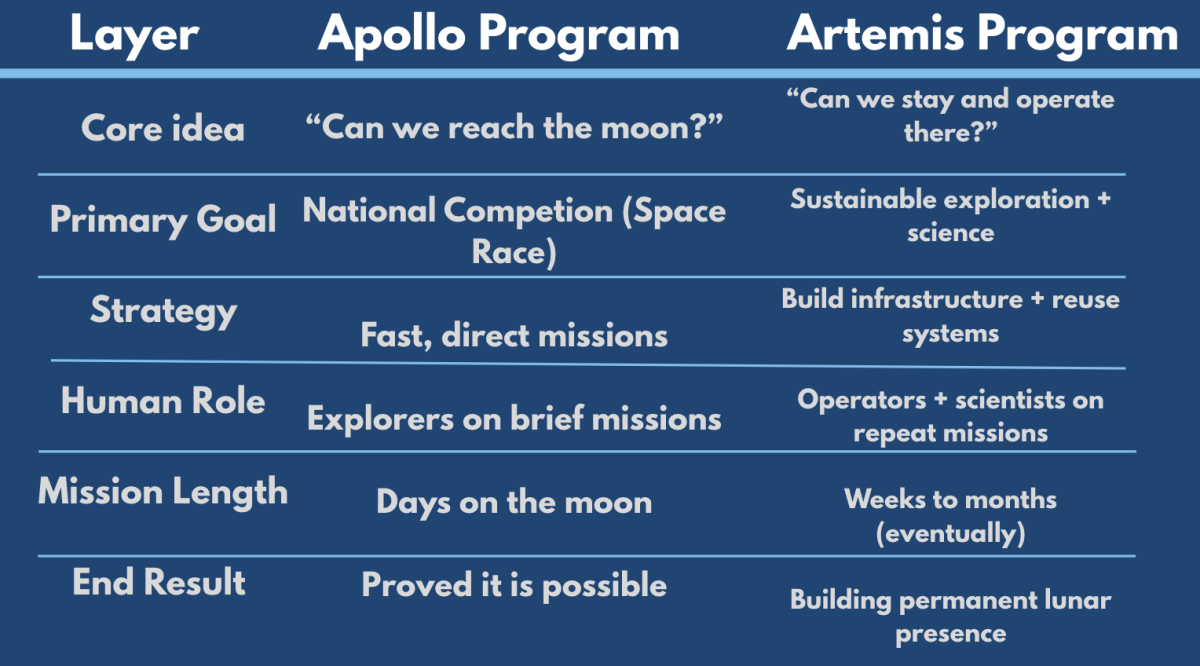
“Artemis II is a stepping stone, so this mission’s purpose is a bridging mission,” Rideout said. “The real excitement is the foundation that it’s laying for the next step, which is to actually build infrastructure on the Moon which no one has ever done before.”

A permanent Moon presence would allow for further scientific research of the Moon, along with a potential to learn more about ancient solar system history. Having a permanent Moon base would additionally allow for better understanding of how humans can function in space, while providing opportunities to learn about the Moon itself.

“Returning to the Moon is definitely the right priority for manned spacecraft right now,” Rideout said. “You’re not gonna be able to set up a habitat on Mars until you’ve done one on the Moon.”

It’s no secret that traveling to both Mars and the Moon are exciting for the world, as it’s the next step for space travel, but Artemis II was still a milestone on its own.

“I mean, we’re all dreamers, right?” Rideout said. “Human beings are all hardwired the same way, so of course it’s special you know, going into space and exploration in general and having new experiences and making heroes out of people, I think that’s human nature, so yeah I think it’s a worldwide sort of milestone in achievement when we do these things.”

Donate to Wayland Student Press
$1385
$2000
Contributed
Our Goal

Your donation will support the student journalists of Wayland High School. Your contribution will allow us to purchase equipment, cover our annual website hosting costs and sponsor admission and traveling costs for the annual JEA journalism convention. Please be aware that the hosting platform retains a 10% processing fee, and donations are not tax-deductible.

Donate to Wayland Student Press
$1385
$2000
Contributed
Our Goal