
![Wayland Historical Society Executive Director Scarlett Hoey explains the history of the Cochituate Gatehouse.
"The exterior is still a nice monument to remember buildings [involved in] water history," Hoey said. "We all drink lots of water, and it's such an important resource that we kind of take for granted nowadays."](https://waylandstudentpress.com/wp-content/uploads/2026/06/IMG_2024-1200x800.jpg)








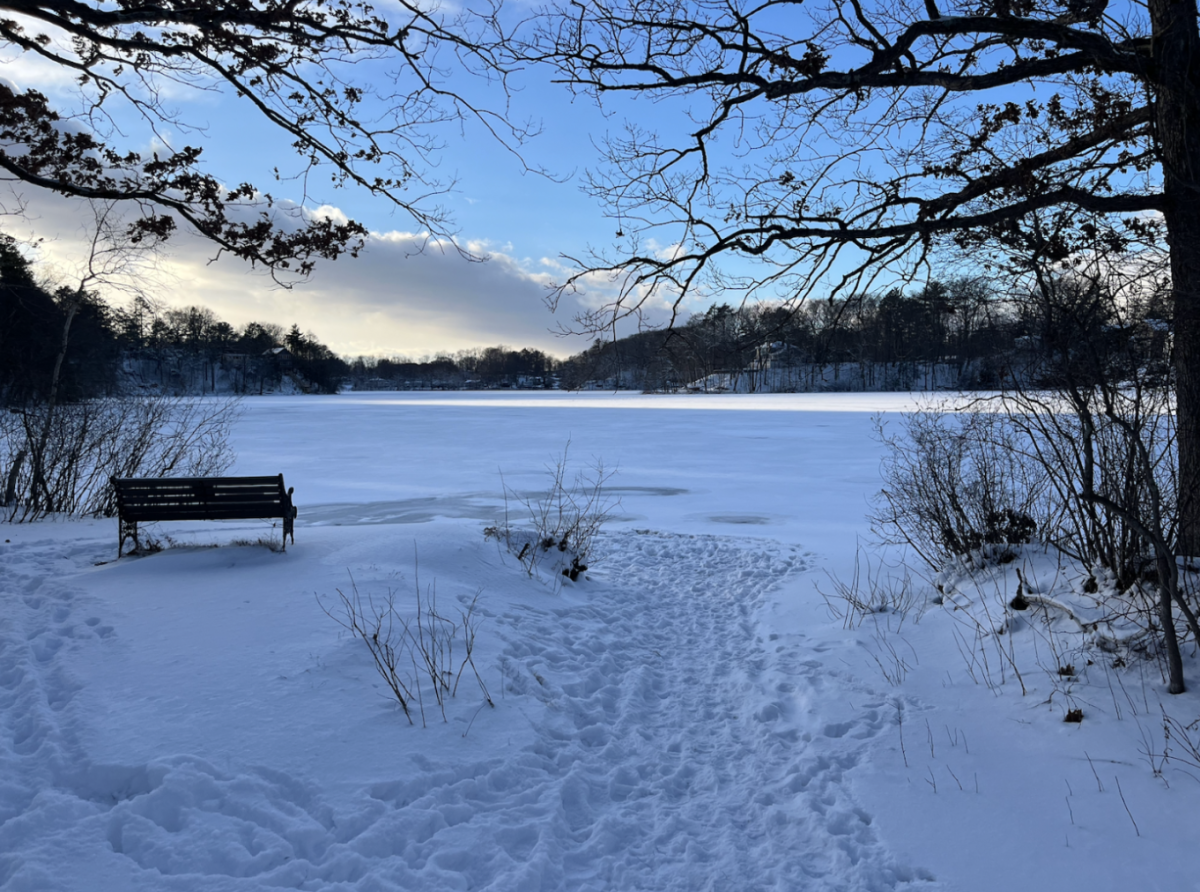
With winter around the corner, many in Wayland are wondering what to expect in this upcoming snowy season. Last winter’s total snowfall was 28.1 inches, which is generally considered below average. This leaves the question of whether this pattern of mild, anticlimactic winters will continue, or is Wayland in for a surprise?
According to CBS news, some early signs of winter have already begun to show. These include the first nor’easter that Massachusetts experienced on Oct.13, the first snowfall on Dec. 2 and fall leaves dropping earlier than usual.
Because the weather is ultimately unpredictable, the National Oceanic and Atmospheric Administration (NOAA) says that there is an equal chance of above or below average precipitation.
“This winter, just in general, is sending some mixed signals,” Blue Hill Observatory Meteorologist Joshua Polen said. “I wish I had an answer that ‘Oh, it’s going to be this for certain,’ but unfortunately, it’s kind of a mixed bag.”
According to Polen, the main “driver” for the winter weather is the El Niño-Southern Oscillation (ENSO), which can change global atmospheric circulation and affect temperature and precipitation patterns around the world. Currently, we are entering La Niña, which typically brings warmer and wetter weather to the Northeast.
“While we might be close to normal for the amount of precipitation we get, the fact that we’re likely to have slightly warmer than normal temperatures means that it might be a bit more difficult to get snowfall,” Polen said. “Hence why this winter, the thinking is that we will be slightly below normal for snowfall.”
However, La Niña is at a weak point right now, according to Polen, which is expected to last until halfway, where it may transition into a more neutral phase by the end of winter. This could mean a “less consistent impact on climate,” according to the NOAA.
“Because [La Niña is] weak, the effect it has on the global atmospheric circulation is much less,” Polen said.
Source: U.S. Climate Data, CBS, NBC Boston
On Tuesday, Dec. 2, Wayland saw its first snowfall of the winter season. Temperatures have also been dropping quickly, reaching as low as 8 degrees on Tuesday, Dec. 9. Although the snowfall was brief and icy, sophomore Heather Maddocks still recalls her excitement in seeing it kick off the winter season.
“I thought that the snow was really pretty at the beginning of the day,” Maddocks said. “It reminded me of snow days in elementary school.”
For snow lovers who picture the holiday season with a blanket of powdery snow, a forecast of a colder winter with below average precipitation may be a bit disappointing. For skiers and snowboarders, a warmer, wetter winter may not provide the most ideal conditions on the slopes.
“[The forecast] makes me so sad because that means there’s going to be a lot more ice,” junior skier and snowboarder Audrey Nugent said. “And there’s gonna be less snow, so it can damage your skis and snowboards.”
Moreover, according to junior skier Maddie Ferrer, fresh snow is typically ideal for skiers, meaning if the weather forecast does shift to allow for more precipitation, a colder winter could have its benefits.
“Fresh snow is just a lot better because there’s less ice,” Ferrer said. “It’s more powdery, and it’s a lot softer to ski on.”
While there aren’t high hopes for a very snowy winter, there are other factors that could come into play, such as the Quasi-Biennial Oscillation (QBO). The QBO refers to the direction of the winds in the stratosphere and helps determine the strength of the polar vortex in the Arctic. If the polar vortex is weaker, more cold air can escape. According to Polen, the QBO is in its easterly phase, which favors more disruptions in the polar vortex and allows more cold air to break free.
“If we can time some of these disruptions and get cold air in place at the same time as precipitation, we could still see some decent snowfalls,” Polen said. “But overall, we think that the snowfall will still be below normal nonetheless, but it probably will be more than last year.”