
![Wayland Historical Society Executive Director Scarlett Hoey explains the history of the Cochituate Gatehouse.
"The exterior is still a nice monument to remember buildings [involved in] water history," Hoey said. "We all drink lots of water, and it's such an important resource that we kind of take for granted nowadays."](https://waylandstudentpress.com/wp-content/uploads/2026/06/IMG_2024-1200x800.jpg)




















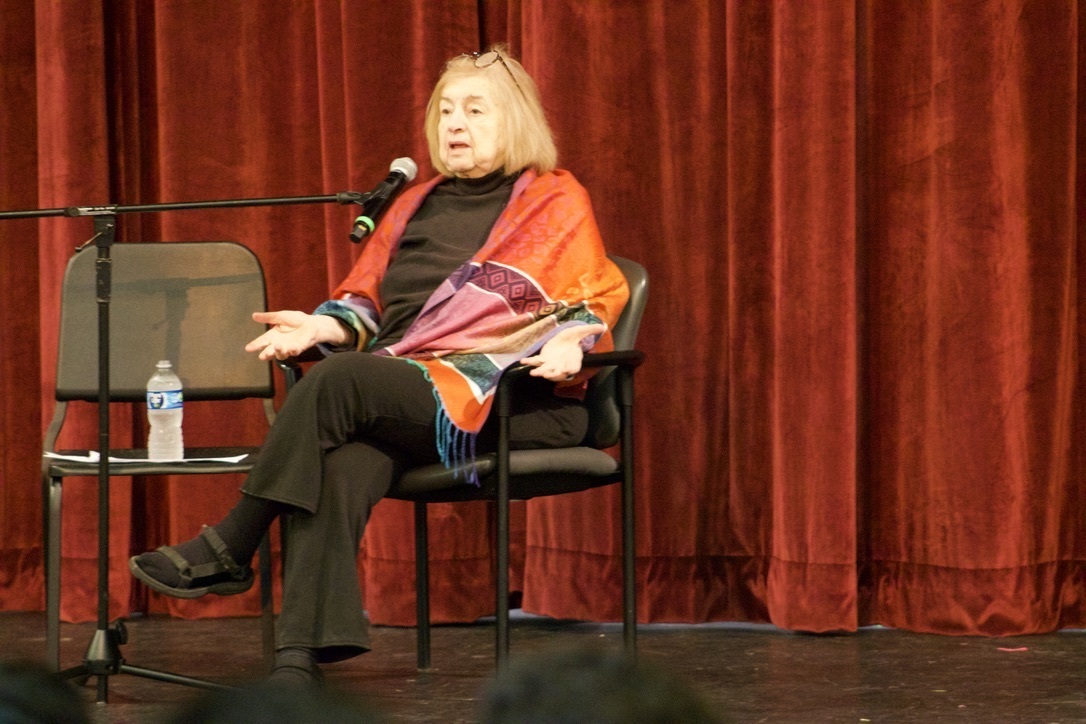
On Tuesday, April 15, Wayland High School welcomed guest speaker Kati Preston to talk about her experience as a Holocaust survivor. The event was originally proposed by seniors and Jewish Student Union Co-Presidents Max Burgess and Ryan Chase who attended a presentation Preston spoke at during their time at Wayland Middle School.
After hearing Preston talk at the event their sophomore year, Burgess and Chase were moved by her story. The two felt that the entire high school should be given the chance to hear Preston’s story. Burgess was particularly inspired by Preston’s focus on active helping instead of being a bystander.
“She’s a great storyteller, and I feel she emphasizes less about the victim part,” Burgess said. “She emphasized how surviving what she went through kind of became more than that.”
Burgess also admired Preston’s ability to speak about heavy events in a way that students could understand and relate to. Others also found her storytelling powerful and moving.
“Many people do know the history [of the Holocaust], but the brutal way in which her father was treated and the detail that she uses, I think, is really important and left the most lasting effect on me,” Burgess said.
History department head and organizer David Schmirer noted Preston’s ability to keep the audience engaged while observing a lack of phones out in the audience.
“The piece that was most important was in the storytelling of how when we think back to the Nazi regime, there was kind of an underlying assumption that everybody just followed along out of fear,” Schmirer said. “[Her story] tells us that you can be resistant to totalitarian forces that are trying to harm you.”
Preston’s storytelling was strengthened by her first hand experience in the event which some past speakers at WHS didn’t have.
“[It was] first hand experiences from someone, rather than watching a video about a Holocaust survivor or listening to someone recount another person’s story,” Chase said. “It’s like hearing it straight from the source really. It leaves a different kind of impact and is able to resonate more.”
Preston’s experience as someone who lived through the Holocaust made the presentation impactful for those in the audience. With more and more Holocaust survivors passing away, fewer individuals are able to share their experiences.
“The world said ‘never again’ after the Holocaust, and there have been a number of genocides that have taken place since, and if you look at the cycle of history, these things come back,” Schmirer said. “Especially as the generation that was alive during that time ages out and all you’re left with is stories that you’re reading on the internet or on books, it becomes easier to change and manipulate people’s minds.”
After surviving the Holocaust as a child in Hungary, Preston went on to build her own life with reliance, strength and purpose. In the years following the Holocaust, she went on to build a successful personal and professional life that included careers in journalism, fashion and education.
Preston’s role in telling her story and Holocaust education includes speaking to groups at historical museums, teacher and administrator conferences, faith groups and local prisons.
Her role as an activist also include advocating for bills to create political change, including a genocide-education bill.
Preston also shared her story in a 2025 movie titled Hidden: The Kati Preston Story. She is also the author author of two books, Holocaust to Healing and From the Ashes of Auschwitz to the El Paso Holocaust Museum, which recount her experiences during the Holocaust and in the years that followed. By sharing her experiences publicly, she ensures her story remains accessible.
Kati Preston’s Story
Preston began her presentation with a description of her early life. Born in 1939 in Hungary, in a town of about 100,000 residents, she was raised as an only child in a loving family. Her parents had an uncommon marriage for the time – a mixed religion marriage.
“My father was a Jew and my mother was a Catholic, and when they got married, it was a big scandal, because people didn’t intermarry,” Preston said. “They just didn’t do that. Both families disowned them properly, and didn’t talk to them.”
Preston’s mother converted to Judaism, making it a historically unusual marriage, as such relationships were rare and discouraged. According to Preston, her parents did not dwell on that, focusing instead on the short time they had together and their happiness.
Preston attended a Jewish kindergarten where she would learn about her heritage, and it was where she first learned that she was Jewish. Of the 52 kids who attended her kindergarten, only two survived to Holocaust.
Kindergarten was Preston’s first exposure to being labeled as Jewish, something she struggled to understand. She felt that she looked and acted just like everybody else and could not understand the label placed on her.
“This idea that I was any different was very alien to me,” Preston said.
Preston explained how the persecution of Jewish people did not happen all at once; instead, it was a gradual process.
“[The persecution of Jewish people] was a slow progression of taking away our freedom”, Preston said.
The changes started as denying Jews college education, medical care and work restrictions. People slowly started disappearing after going to police stations. Then, Jewish people were eventually forced to wear a yellow star in order to identify themselves.
When Preston was a child, a stranger spat on her face after seeing the star on her clothing. At first, she did not understand that the man hated her because she was Jewish.
Soon, it progressed to the point where Jews were taken from their homes and sent to ghettos. Eventually, Preston’s father was taken to the largest German Nazi concentration camp, Auchwitz, but as a child, she could not fully grasp the severity of the situation.
“My mother was inconsolable,” Preston said. “I couldn’t stop her crying. I couldn’t understand why she was so distraught.”
She described feeling confused as she saw the streets filled with cars and large trucks, and soldiers in green uniforms with black feathers in their hats. The soldiers carried weapons, including whips and guns, which they used to drag Jewish residents from their homes and force them onto the vehicles as they cried and screamed. Preston recalled wanting to help the pets left behind by the families who were taken, but being unable to do so.
Her mother kept her hidden, and Preston was not allowed to run around or be near the windows. Around this time, their milk-woman, Elizabeth, was getting married, and Preston’s mother made her a wedding dress for the occasion. In return, Elizabeth offered to take Preston to her farm and keep her hidden from the Nazi’s there. This action ultimately saved her life, as it was a only a matter of time before Preston would have been found by the authorities.
“It really is that wedding dress that saved my life,” Preston said. “Every time I see a wedding dress, I get a pang. I always think of wedding dresses as being freedom, life.”
After time considering Elizabeth’s offer, Preston’s mother made the difficult decision to send Preston away with Elizabeth to the farm, where she lived in the attic of the barn.
“I was delighted,” Preston said. “I thought there’ll be puppies, and kittens and children to play with. I sat next to [Elizabeth] on the bench, and I felt really grown up. I was almost five now, and I was very happy.”
Preston described her experience going from a spoiled child to being forced to hide in limiting conditions with death as a constant threat. However, she still was unable to really understand her situation.
“[Elizabeth] kept telling me that I had to be very quiet because people want to kill me, and I was getting very tired of this killing business,” Preston said. “I really believed she just didn’t want me in her house.”
Once the Russian occupation started, Preston was able to return home with her mother. However, the occupation brought air raids and starvation and made them go without electricity, water or heat.
“Hunger completely takes possession of you,” Preston said. “It becomes your whole being. All you can think about is food.”
Preston recounted how her city block survived for an entire week by eating a horse after it was abandoned and died in the street.
“I love horses,” Preston said. “I couldn’t eat one now. But when you are hungry, you can eat anything. We were so hungry. So terribly hungry. It was awful.”
Preston’s mother eventually secured food by disguising herself as an old woman he and her daughter’s safety and offering to make a dress for a local Russian Commander, who was a woman. As a result, the Russian army brought them chicken, fruit and even a piece of chocolate.
After the Russian occupation, Preston’s mother told her to dress up because they were going to the railway station to meet her father, as three trains were arriving from Poland. She described feeling scared looking at the people coming off the train.
“They didn’t look human,” Preston said. “They were dressed in rags. They had sores all over, no hair, [I] couldn’t tell if they were men or women, and they didn’t talk, they whispered, and they didn’t walk, they shuffled. They were like ghosts.”
For three days, Preston and her mother stood on the platform holding a picture of her father and asking people if they had seen him, but they never found him. On the last day, a close family friend told them that her father had already died. At first, Preston’s mother did not even recognize him.
“[My father’s friend] became so badly beaten that he was unrecognizable,” Preston said. “He was also a very good violinist, and they broke all his fingers in the camp, and they didn’t set it. So he had hands like claws, which scared me.”
After the war, Preston found out that her father had been beaten until most of his bones were broken and left in a kennel to slowly die over the course of three days.
“When I heard this, I became full of hatred,” Preston said. “I just wanted to kill somebody. I wanted revenge. It took me 50 years to stop hating. I don’t hate anymore, because when your heart is full of hate, there’s no room for anything else.”
Preston ended the talk by reflecting on this period in her life and drawing parallels between today’s situation in the U.S. and her experiences during the holocaust. She compared things such as Immigration and Customs Enforcement (ICE) and Neo-Nazis to what she had lived through before.
“I cannot understand for the life of me, somebody waving a Nazi flag,” Preston said. “It baffles me. I mean, your grandparents fought those people, they lost. And why is the grandchild waving a loser flag? You want to join the losers? How stupid is that?”
She ended the talk by emphasizing the modern generation’s role in improving the world. Preston talked about how the newer generations are less focused on fame and money and are more accepting of others.
“You are a good generation and you’re going to save the world,” Preston said.