
![Wayland Historical Society Executive Director Scarlett Hoey explains the history of the Cochituate Gatehouse.
"The exterior is still a nice monument to remember buildings [involved in] water history," Hoey said. "We all drink lots of water, and it's such an important resource that we kind of take for granted nowadays."](https://waylandstudentpress.com/wp-content/uploads/2026/06/IMG_2024-1200x800.jpg)


















![This photo features the historical house plaque on Samuel Griffin's House. "Historical houses say a lot about the history of the land and the people who came before us, and there's a lot of good solid workmanship that goes into the old houses that you don't see much [of] today," Scola said.](https://waylandstudentpress.com/wp-content/uploads/2026/05/60176CC6-6330-4683-AE08-0375EC716CE1-1200x800.jpg)
What does it feel like to step inside someone else’s life from over a century ago? This is what Wayland Historical Society’s Still Standing tour visitors experienced as they strolled through hallways filled with antique period-pieces and creaky wood floors.
On Sunday, May 3, the Wayland Historical Society offered a public self-guided tour of five featured historical homes in Wayland. Titled Still Standing, the tour was aimed at raising awareness and appreciation for the preservation of history in Wayland.
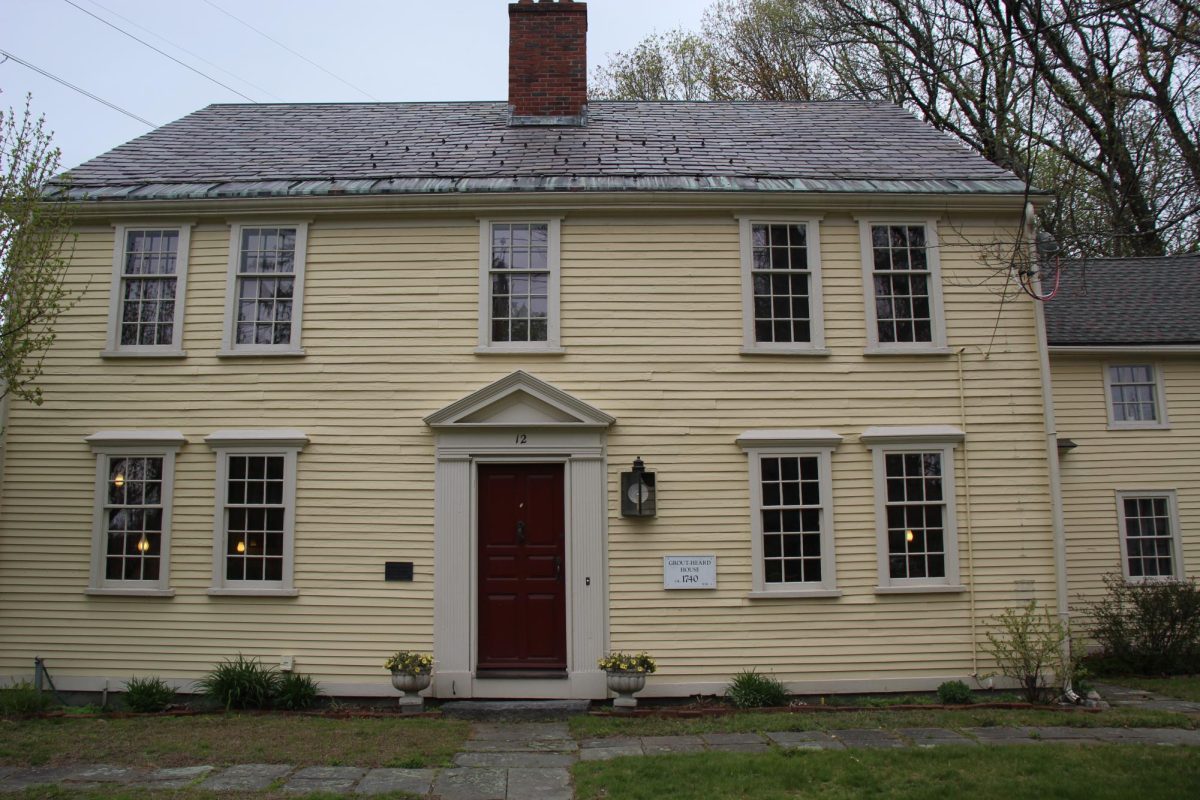
Before stepping into the different historical homes, visitors went to the Grout Heard House, where volunteers greeted visitors and handed them pamphlets, serving as the tickets for the tour. The pamphlets included a map of each house that the home owners would cross off once you arrived. The Grand Heard House was built around 1740 and is now a museum run by the Wayland Historical Society, an organization dedicated to preserving and educating people about Wayland’s history.
Sophomore volunteer Noa Ferdman works with Minuteman National Historical Park and has an interest in local history due to the valuable perspectives it provides. Ferdman appreciates how much more work used to go into producing products, since they used to be mostly made by hand.
“It’s good to see how much effort people put into little things because [back then], products weren’t being mass produced,” Ferdman said.
Visitor Shidaun Pryor, who has lived in Wayland for over 61 years, said that seeing homes firsthand offers a deeper understanding of how people once lived. According to Pryor, the experience is especially important for younger generations to help them stay connected to the past.
“I’m very interested in seeing how people lived back in that era,” Pryor said.
Hopestill Bent Tavern:
Built around 1720, the Hopestill Bent Tavern is one of Wayland’s oldest surviving homes. It was once a tavern run by Hopestill Bent, serving travelers on Old Connecticut Path until 1780.
The house has original features, such as wooden beams and a unique staircase that are still intact. According to a pamphlet handed out at the tour, its exterior reflects a Federal style, which today is recognized as one of the most architecturally significant First-Period styles in Middlesex County.
Dustin Mulcahey, who bought this merlot historical house with his wife two years ago, sees himself less as the owner of the house, and more as the caretaker of its history. He says one of his favorite parts of living in the house is its character, from the original fireplace to the way that most rooms are separated with doors.
“Heritage, history and aesthetics are more important for us than having five bathrooms and [a] 5,000 square feet [home],” Mulcahey said.
Rather than modernizing their house, the couple has chosen to furnish it with period-style pieces to match its design. Mulcahey believes that preserving the home is important in order to respect the history it contains.
“You can’t make new old houses anymore, [and] that’s the biggest reason [to preserve this house],” Mulcahey said. “When you live here you feel that connection.”
For him, living in the Hopestill Bent Tavern creates a unique connection to the past, one that makes a home feel more than just a place to live.
“I like how I come home everyday, and I like what I look at,” Mulcahey said.
Visitors Alison Ridge and Mike Fabrizio, who recently moved to Wayland, went on the tour to learn about their new community. They were surprised by the details of the house and how well the home had been maintained. Fabrizio, who grew up in Carlisle, MA, emphasized the importance of preserving historical homes.
“We see a lot of these modern, new age homes going up, and I think it’s important to keep and maintain some of the older buildings.” Fabrizio said.
Zechariah Bryant Jr. House:
The Zechariah Bryant Jr. House was built in the 1770s as a colonial hall. It was constructed by Zechariah Bryant Jr., a soldier who marched in the Battle of Lexington and Concord. In 1875, Hodijah Bramen, a farmer, had the house relocated to where it currently stands. During the relocation, the house underwent renovations, including adding in a Palladian window, which is a large window with three main parts and a central arch. The home still has the original room layout and foundation today and is 3,348 square feet.
Samuel Griffin House:
Built in 1720, the Samuel Griffin House is another one of the oldest homes in Wayland and was originally part of Samuel Griffin’s homestead. The home lasted through the American Revolution in the 1760s.
It was later home to Deacon Jonathan Griffin, an important religious figure in the early 1700s. The house still has original features, like its slightly off-center front door and sits over an acre of land that has stayed mostly the same since that time.
For home owner and Wayland Historical Society board member, Elisa Scola, her family’s pale turquoise house is more than just a place to live, it’s a connection to centuries of history and served as the place Scola raised her family.
While living in the home, Scola developed a passion for gardening, filling the yard with plants native to MA to attract birds and different wildlife. Gardening helps Scola view the historical property as both a living space and a piece of the past worth preserving.
“[I like to] think about the people who lived here before me and how much history there is,” Scola said.
Scola’s daughter Patricia Pak claimed that growing up in a historical house feels completely normal to her. Pak is interested in the older features of the home, such as the low ceilings, fireplace and the wood burning stove, which help keep the home warm during older months.
“I really love it, [and] think it’s phenomenal […] I feel like it really is the history of the past, knowing that so many people lived and loved this home,” Pak said.
Scola has opened her home as a part of a larger effort to make sure this event was successful, being one of the Wayland Historical Museum’s major fundraisers. More than anything, she hopes visitors leave with a new appreciation for preservation and encourages others to value and protect historical houses, rather than tear them down.
“I hope that people can see that you can live in a historical home, [and] you should not tear them down,” Scola said. “They are beautiful, they’re solid, they’re well made and you can raise a family in these houses and still have all the modern conveniences.”
Ephraim Sherman House:
Built around 1755, the colonial home of the Ephraim Sherman House belonged to the Sherman family, who owned much of the land in northern Wayland. It was later expanded around 1820. From 1831 to 1845, the house was used as a town almshouse, providing shelter for people in need, making it a rare example of municipal poor relief in 19th century New England. Today it still hangs near the Sudbury River in an area that looks similar to its farming days.
Rev. Josiah Bridge House:
Built in 1761, the Georgian home of Rev. Josiah Bridge is located on a hill that dates back to 1638-1639 above Old Sudbury. The home was first constructed for Rev. Josiah Bridge, a MA congregational minister. After Bridge’s death, his sons ran a general store in an area of the house from 1790-1815.
By the mid-19th century, it was a dairy farm under Eli Sherman, who by 1850 kept the largest herd of cows in Wayland. The wide wrap-around porch supported by Doric columns reflected a Greek Revival update from around the 1800s that gives the house its persona today.
According to sophomore Samantha Taurisano, who lives in the house, the house was rebuilt after a fire and later renovated to make it more livable while still preserving history. The owners kept many original features, like uneven floors, varying ceiling heights, old doors, built-in shelves and a fireplace with unused ovens, in order to give the home more character. They focused on maintaining as much of the original structure as they could.
From the people who live in these homes to those who visited them for a single afternoon, visitors were able to see that the historical houses in our community are living connections to the past. By preserving them, the community keeps its history alive while still making space for the present.
“[I] just [have] a greater appreciation for historical homes,” Pak said. “I know that a lot of historical [houses] tend to be demolished because people don’t care about the history, so I just hope [that] you take a great respect for this home.”