![Wayland Historical Society Executive Director Scarlett Hoey explains the history of the Cochituate Gatehouse.
"The exterior is still a nice monument to remember buildings [involved in] water history," Hoey said. "We all drink lots of water, and it's such an important resource that we kind of take for granted nowadays."](https://waylandstudentpress.com/wp-content/uploads/2026/06/IMG_2024-1200x800.jpg)











On Thursday, April 30, Conversations for Change held their last public discussion at the Wayland Town Library. Conversations for Change is a discussion group created by the Library Board of Trustees and proctored by CEO of Pluralism Solutions Eden-Reneé Hayes.
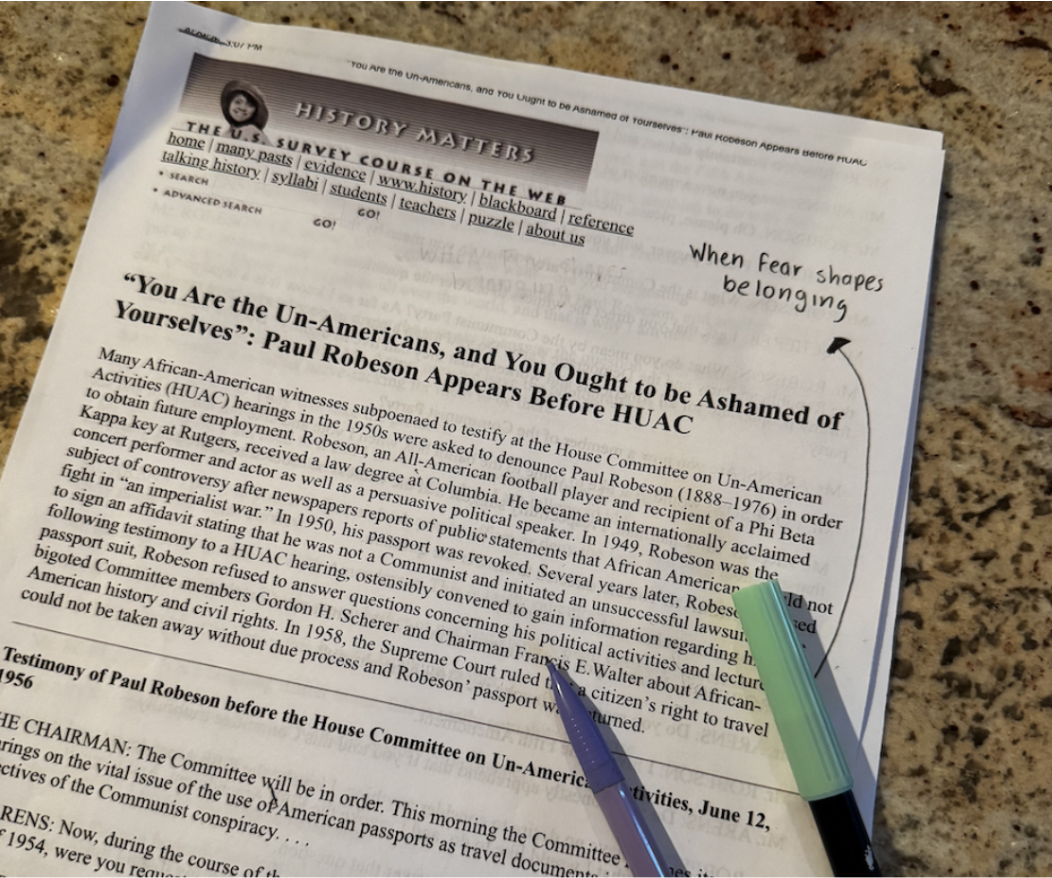
Town members filed into the Wayland Public Library for the 6th and last session of Conversations for Change on Thursday, April 30, at 7 p.m.. The last conversation was centered on how fear can be a tool for discrimination and featured a reading of activist and actor Paul Robeson’s appearance before the House of Un-American Activities Committee (HUAC) in 1954.
Conversations for Change is a public discussion group hosted by the library and sponsored by the Wayland Historical Society and the Human Rights, Diversity, Equity and Inclusion Committee (HRDEI).
The initiative was started after the library opened its doors to an annual reading of Fredrick Douglas’s 1852 speech “What to the slave is the Fourth of July?” this past summer. After the event, some town members requested more textual analysis and discussions focused on racism and discrimination in America
“People came up to me and were saying they really enjoyed this,” Chair of the Board of Library Trustees Aida Gennis said. “They felt it was very impactful.”
The positive and engaging response from the reading prompted Gennis to collaborate with the Board of Library Trustees and created Conversations for Change, a recurring conversation program designed to analyze discrimination and its role today through the study of historical documents. The discussions strived to create a place where varying perspectives, thoughts and experiences could be shared in a safe environment.
“We came together to think about how we could continue that,” Gennis said. “We all come from different places, and getting to know somebody by talking and asking questions is so much more productive and allows us to understand and know other people, instead of making judgments without conversation”
The mediator, who picked the documents and posed the questions, was CEO of Pluralism Solutions Eden-Reneé Hayes. Hayes headed the discussions in hopes of educating Wayland community members about inequality and providing a space where systemic and cultural racist patterns could be addressed and discussed.
“I really wanted people to have that opportunity to get more in their brains that’s against the bias that we are unwittingly getting,” Hayes said.
The final conversation was centered on an expert from Paul Robeson’s appearance before the former House of Representative committee designed to find communists, the House of Un-American Activities Committee (HUAC), in 1954. He was called upon by HUAC after he refused to sign a waiver saying he wasn’t a communist. Robeson was a renaissance man, having been an activist, author, professional football player, actor and concert artist. After being blacklisted from Hollywood on accusations of communism, he leaned into activism concerning the un-American and discriminatory methods of HUAC.
In Robeson’s testimony, he called upon civil rights violations in the country and noted that HUAC was using communism as a veil to hide their true intention, which was to silence the fight for African American rights.
After listening to the excerpt, Hayes opened the conversation up to town members’ reactions and emotions following the testimony. Topics of belonging, humanization and how the current political environment mirrors that of the 1950s were brought up in the initial conversation.
“Each time I brought a historical document and brought it to today, and it was really just a goal of trying to get people to self-reflect, and get everyone to realize a lot of the things that we saw in the past are still being repeated,” Hayes said. “It’s giving us an opportunity to stop and consider what is it that we can do in our own communities?”
After the conversation died out, Hayes posed questions about the extent at which town members have the power to label others as dangerous or unpatriotic, which was later followed by a conversation on how people influence belonging.
The session ended at 8:30 p.m., with closing sentiments focused on the importance of choosing curiosity over fear, handling debates with respect and engaging in community efforts to become a more thoughtful person.
“People have been able to come here exposed to ideas and conversation that may be difficult, and have others listen to them and engage in it with them, and hopefully feeling some sense of acknowledgement that there are others who are in similar situations,” Gennis said. “Hopefully they enact what they have heard or how they have felt, and reach out to others and bring some more understanding.”